- 27/07/2026
INFORMATION ON WEST NILE FEVER CASES
Situation in Europe in 2026
According to the latest available information on West Nile fever from the European Centre for Disease Prevention and Control (ECDC), as of 22 July 2026, since the beginning of the 2026 transmission season, 35 regions in six European countries have reported circulation of West Nile virus (WNV).
These regions are located in Italy (20), Greece (6), Romania (4), Macedonia (2), Spain (2), and France (1).
The six countries have reported a total of 81 autochthonous (locally acquired) cases of West Nile virus infection. Of these, Italy reported 46 cases, Greece 21, Macedonia 5 (as of 22 July; 8 cases in total to date), Romania 5, Spain 3, and France 1 case.
During the current transmission season, the first reported human case in the WHO European Region was recorded in Macedonia.
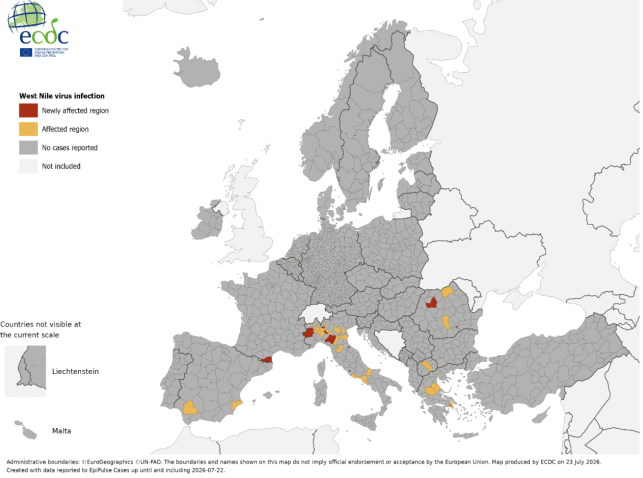
For the latest surveillance data, see the ECDC website:
https://www.ecdc.europa.eu/en/west-nile-fever/surveillance-and-disease-data/disease-data-ecdc
Situation in Macedonia in 2026
West Nile fever was first recorded in Macedonia in 2011. Between 2011 and the end of 2025, a total of 54 laboratory-confirmed cases were reported, including five deaths associated with the disease.
As of 27 July 2026, eight cases of West Nile fever have been reported in Macedonia.
According to the case definition, seven cases are confirmed and one is classified as probable.
Six locally acquired (autochthonous) cases have been reported from Skopje and Veles, while one case from Skopje had a recent travel history to Greece; however, the incubation period also included time spent in North Macedonia.
Of the eight reported cases, seven occurred in men and one in a woman. Most patients (six) were over 60 years of age, while two were aged 50–59 years.
All reported cases in 2026 presented with neuroinvasive disease, and all required hospitalisation.
Symptom onset occurred in July for five cases, June for two cases, and May for one case.
Disease Overview
West Nile virus (WNV) is an arbovirus belonging to the Flavivirus genus. It was first identified in Uganda in 1937 and has since been documented across Africa, the Americas, Asia, Australia, Europe, and the Middle East.
West Nile fever is a mosquito-borne viral disease maintained in an enzootic cycle between mosquitoes (primarily Culex species, but also Aedes species) and birds, particularly wild birds. Humans and horses are incidental, dead-end hosts and play only a limited role in the natural transmission cycle.
People are most commonly infected through the bite of an infected mosquito. The disease is not transmitted from person to person, except in rare situations such as blood transfusion or organ transplantation.
The incubation period is usually 3–14 days.
Approximately 80% of human infections are asymptomatic. Among symptomatic infections, most present as a self-limiting febrile illness. Fewer than 1% of infections progress to severe neuroinvasive disease, such as encephalitis, meningitis, or acute flaccid paralysis, which can be life-threatening.
There is no specific antiviral treatment. Management is supportive and focuses on relieving symptoms. Prompt intensive medical care improves survival in severe cases. The case fatality rate among severe cases ranges from 3% to 15%, increasing with age. Recovery may be prolonged and can include persistent fatigue, muscle weakness, difficulty walking, memory impairment, depression, and other long-term complications.
There is currently no vaccine available for humans.
The most effective method of prevention is to avoid mosquito bites.
Seasonal surveillance in Europe is conducted from June through November, corresponding to the period of mosquito activity.
Risk Assessment
In North Macedonia, West Nile fever occurs sporadically, most often among patients with neuroinvasive disease who undergo laboratory testing.
Vector-borne diseases are being reported with increasing frequency. Climate change, the expansion of mosquito vectors, and increased international travel—including travel by residents of Macedonia to endemic areas—have increased both the risk of infection and the possibility of introducing these diseases into the country.
Further locally acquired or imported cases may therefore be expected across the country during the mosquito season. The overall risk to the population is considered moderate, but it can be substantially reduced by following the preventive recommendations issued by the competent authorities.
Recommended Public Health Measures
Increase public awareness through education about West Nile fever, its modes of transmission, and preventive measures. Educational materials should be made available on the websites of the Institute of Public Health and all ten Centres for Public Health, and shared with travel agencies for distribution to travellers visiting endemic areas.
Centres for Public Health should inform primary care physicians and infectious disease specialists about the current epidemiological situation to increase awareness and ensure West Nile fever is considered in the differential diagnosis of compatible illnesses.
Strengthen mosquito surveillance, including monitoring mosquito populations, identifying vector species, and testing for West Nile virus and other vector-borne pathogens.
Municipalities should implement planned larval and adult mosquito control measures in accordance with approved programmes. Additional targeted vector control should be undertaken around confirmed cases based on epidemiological indications by the relevant Centres for Public Health.
Develop a National Programme for Zoonotic and Vector-Borne Diseases, together with a national action plan for prevention and response to imported and locally acquired cases.
Strengthen coordinated collaboration between the public health, veterinary, and environmental sectors in accordance with the One Health approach.
Preventing Mosquito-Borne Diseases
Environmental Measures
Reduce mosquito breeding sites by:
· eliminating standing water from barrels, buckets, boats, canoes, discarded tyres, and other containers;
· cleaning gutters regularly to ensure proper drainage;
· maintaining swimming pools, ornamental ponds, and fountains;
· preventing the formation of stagnant water around homes.
· Reduce exposure to mosquitoes by:
· using mosquito coils, citronella candles, or other outdoor repellents;
· using mosquito traps or electronic mosquito-repelling devices;
· installing insect screens on doors and windows;
· avoiding outdoor activities at dawn and dusk, when mosquitoes are most active.
Personal Protection
· Wear light-coloured clothing that covers as much of the body as possible, including long sleeves, long trousers, socks, and hats.
· Apply mosquito repellents to exposed skin and clothing according to the manufacturer's instructions.
· Do not apply repellents to cuts, open wounds, under clothing, around the eyes or mouth, or to the palms of the hands. Use particular caution when applying repellents to young children.
· Travellers visiting areas where mosquito-borne diseases occur should use insect repellents consistently and sleep in rooms protected by insecticide-treated window screens or bed nets whenever appropriate.
· After returning home, travellers should remain alert for symptoms that may develop following travel. If symptoms occur, they should seek medical attention promptly and inform their healthcare provider about their recent travel history. Early diagnosis and timely treatment can reduce the risk of severe disease and serious complications.
The Institute of Public Health has the laboratory capacity and reagents required to test human specimens for West Nile virus infection.
The Department of Epidemiology of Communicable Diseases regularly publishes updates on the epidemiological situation in its monthly bulletins on acute communicable diseases.
Department of Epidemiology of Communicable Diseases
Institute of Public Health of the Republic of North Macedonia
27 July 2026